⏰LIMITED TIME:
FREE EU SHIPPING — NO MINIMUM ORDER
🚚⏰LIMITED TIME:
FREE EU SHIPPING — NO MINIMUM ORDER
🚚⏰LIMITED TIME:
FREE EU SHIPPING — NO MINIMUM ORDER
🚚
⏰LIMITED TIME:
FREE EU SHIPPING — NO MINIMUM ORDER
🚚⏰LIMITED TIME:
FREE EU SHIPPING — NO MINIMUM ORDER
🚚⏰LIMITED TIME:
FREE EU SHIPPING — NO MINIMUM ORDER
🚚
⏰LIMITED TIME:
FREE EU SHIPPING — NO MINIMUM ORDER
🚚⏰LIMITED TIME:
FREE EU SHIPPING — NO MINIMUM ORDER
🚚⏰LIMITED TIME:
FREE EU SHIPPING — NO MINIMUM ORDER
🚚
⏰LIMITED TIME:
FREE EU SHIPPING — NO MINIMUM ORDER
🚚⏰LIMITED TIME:
FREE EU SHIPPING — NO MINIMUM ORDER
🚚⏰LIMITED TIME:
FREE EU SHIPPING — NO MINIMUM ORDER
🚚
Choosing vacuum filtration equipment is easier when the selection starts with the liquid, required filtration level and routine batch volume. A system that is too small slows the workflow, while the wrong membrane or pore size can reduce flow or affect sample recovery. This guide explains the main purchasing factors for laboratory media and aqueous solutions.
What counts as laboratory vacuum filtration equipment?
A typical laboratory vacuum filtration system combines an upper funnel, a membrane, a vacuum connection and a receiving bottle. Vacuum draws the liquid through the membrane into the receiver. Complete disposable systems reduce assembly steps and are convenient when laboratories need a ready-to-use setup. Bottle-top filters may be preferable when a compatible receiving bottle is already part of the workflow.
Start with the liquid and filtration goal
First identify what is being filtered and why. Cell-culture media, buffers and other aqueous laboratory solutions may require different membrane characteristics from aggressive solvents. Consider whether the purpose is clarification, routine sterile filtration or finer particle and microorganism retention. For critical work, check the validated protocol and the chemical compatibility information for the exact solution rather than selecting by pore size alone.
Choose the appropriate pore size
0.45 μm: commonly considered for clarification or as a prefiltration step when the liquid contains more particulates.
0.22 μm: a widely used choice for routine sterile filtration of compatible aqueous solutions and cell-culture media.
0.10 μm: provides finer retention where a validated protocol calls for it, although the smaller pore size may reduce flow.
A smaller pore size is not automatically better. Sample viscosity, particulate load, required throughput and the target application all influence the practical choice. If a solution clogs a fine membrane quickly, staged filtration may be more efficient.
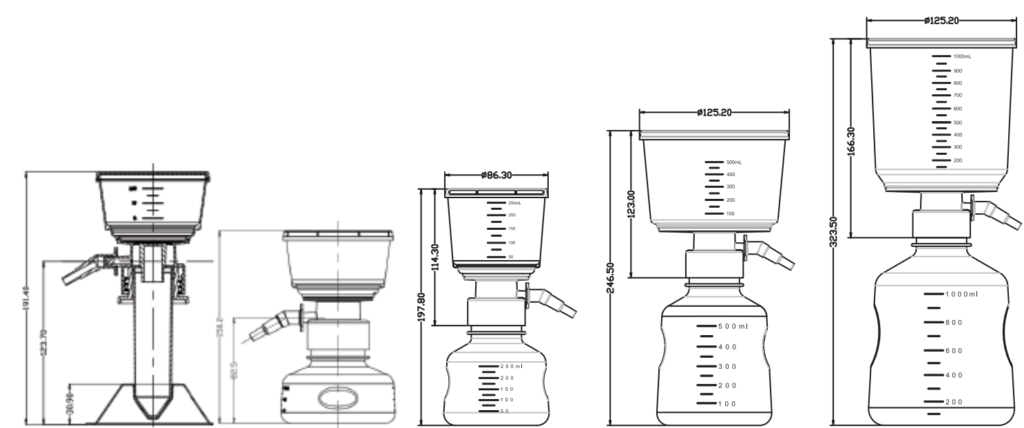
System dimensions vary by capacity; confirm available formats before ordering.
Match system capacity to the batch size
Select a capacity close to the volume normally processed. A 250 mL system suits smaller preparations and helps reduce unnecessary handling space. A 500 mL system is a practical middle option for many routine workflows. A 1,000 mL system supports larger batches and can reduce repeated transfers. Allow sufficient headspace and do not assume the nominal container size is the recommended working volume for every procedure.
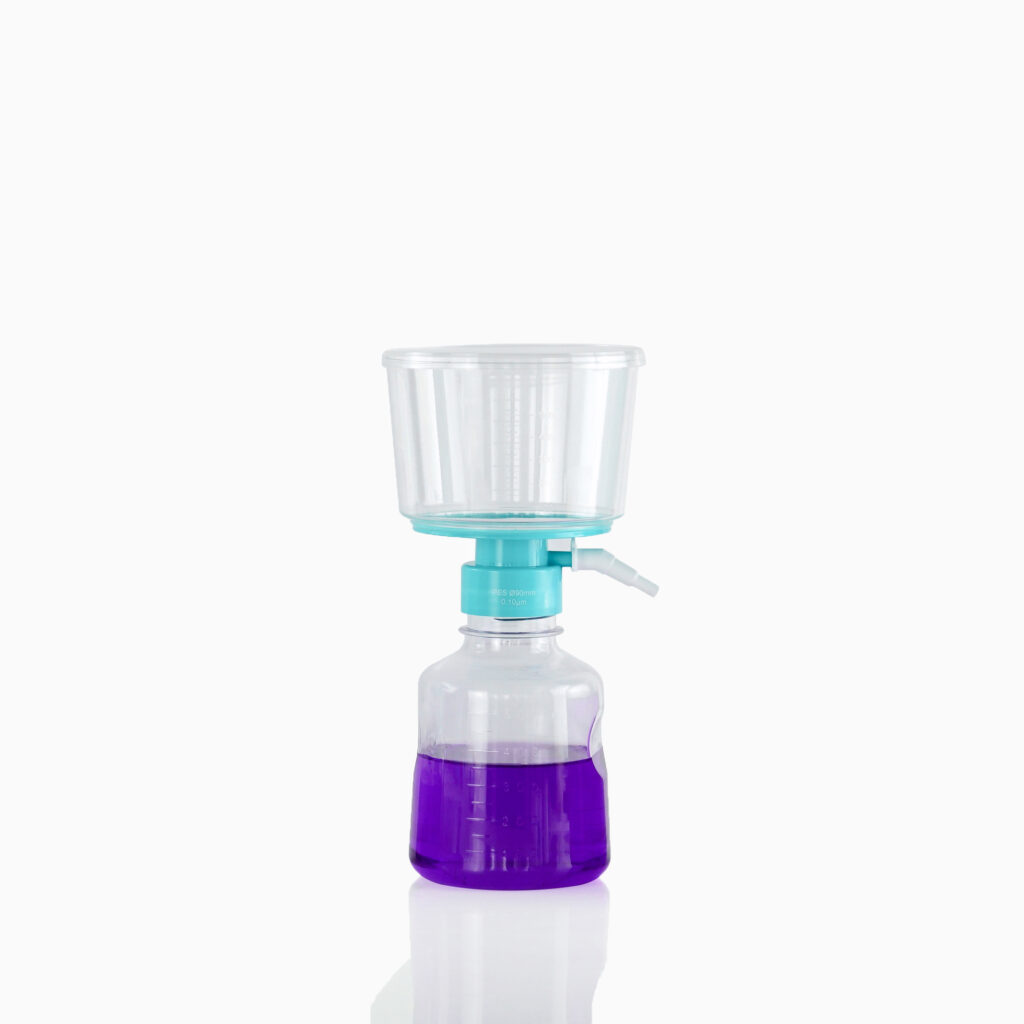
A 500 mL complete vacuum filtration system for routine laboratory workflows.
Check membrane compatibility
The membrane affects flow, binding and chemical compatibility. Hydrophilic PES membranes are widely used for aqueous solutions because they offer high flow and relatively low protein binding. They are often selected for cell-culture media and biological buffers. Other membrane materials may be more suitable for specific solvents or process requirements, so the liquid formulation should always be checked against the supplier’s compatibility data.
Complete system or filter top?
A complete system includes the receiving bottle and simplifies ordering, setup and transfer. It is useful when a consistent closed workflow is the priority. A filter top can offer more flexibility when the laboratory already uses compatible bottles or wants to separate filtration and storage choices. Before buying, confirm connector fit, bottle compatibility, membrane specification, sterility status and package quantity.
Laboratory purchasing checklist
Liquid type and chemical compatibility
Required pore size and membrane material
Routine batch volume and receiving capacity
Expected flow rate and particulate load
Sterile or non-sterile requirement
Complete system or bottle-top format
Packaging quantity, storage and delivery needs
NEST offers sterile vacuum filtration systems and filter tops with PES membrane options in multiple capacities and pore sizes. Review the available specifications on the product page and select the configuration that matches your protocol.
Frequently asked questions
What capacity should I choose?
Choose the capacity closest to your routine batch size while allowing adequate headspace. Smaller systems suit low-volume preparation; 500 mL is a versatile laboratory format; 1,000 mL helps reduce repeated handling for larger batches.
Is a 0.22 μm membrane always the right choice?
No. It is widely used for routine sterile filtration, but the correct choice depends on the protocol, particulate load, required retention and flow. A 0.45 μm option may be useful for clarification, while 0.10 μm may be specified for finer retention.
Is PES suitable for cell-culture media?
Hydrophilic PES is commonly selected for aqueous biological solutions because of its high flow and relatively low protein binding. Confirm compatibility with the complete formulation before use.
Should I buy a complete system or a bottle-top filter?
Choose a complete system when you want an integrated funnel and receiver. Choose a filter top when compatible receiving bottles are already available and your workflow benefits from separate component selection.
Choose a configuration for your workflow
Compare the available NEST configurations by capacity, membrane and pore size. For product selection, bulk purchasing or application questions, contact the NEST team.
Cookies are small text files that can be used by websites to make a user's experience more efficient. The law states that we can store cookies on your device if they are strictly necessary for the operation of this site. For all other types of cookies we need your permission. This site uses different types of cookies. Some cookies are placed by third party services that appear on our pages.
Necessary cookies help make a website usable by enabling basic functions like page navigation and access to secure areas of the website. The website cannot function properly without these cookies.
Marketing cookies are used to track visitors across websites. The intention is to display ads that are relevant and engaging for the individual user and thereby more valuable for publishers and third party advertisers.
Preference cookies enable a website to remember information that changes the way the website behaves or looks, like your preferred language or the region that you are in.