
Free EU Shipping on Orders €200+ 🚚
Free EU Shipping on Orders €200+ 🚚
Free EU Shipping on Orders €200+ 🚚




Choosing between filtered and unfiltered pipette tips depends on the sample, contamination risk, required purity level and laboratory method. Filtered tips add a barrier between the liquid and pipette; unfiltered tips are often the practical choice for routine, lower-risk liquid handling.
This guide explains the difference and provides a simple way to choose.
What Is the Difference?
A filtered pipette tip contains a porous filter inside the tip. It helps limit aerosols and accidentally aspirated liquid from reaching the pipette shaft. This can reduce the risk of contaminating the pipette and carrying material into later samples.
An unfiltered pipette tip has an open air path. It is commonly used for routine transfers when an aerosol barrier is not required by the protocol or risk assessment.
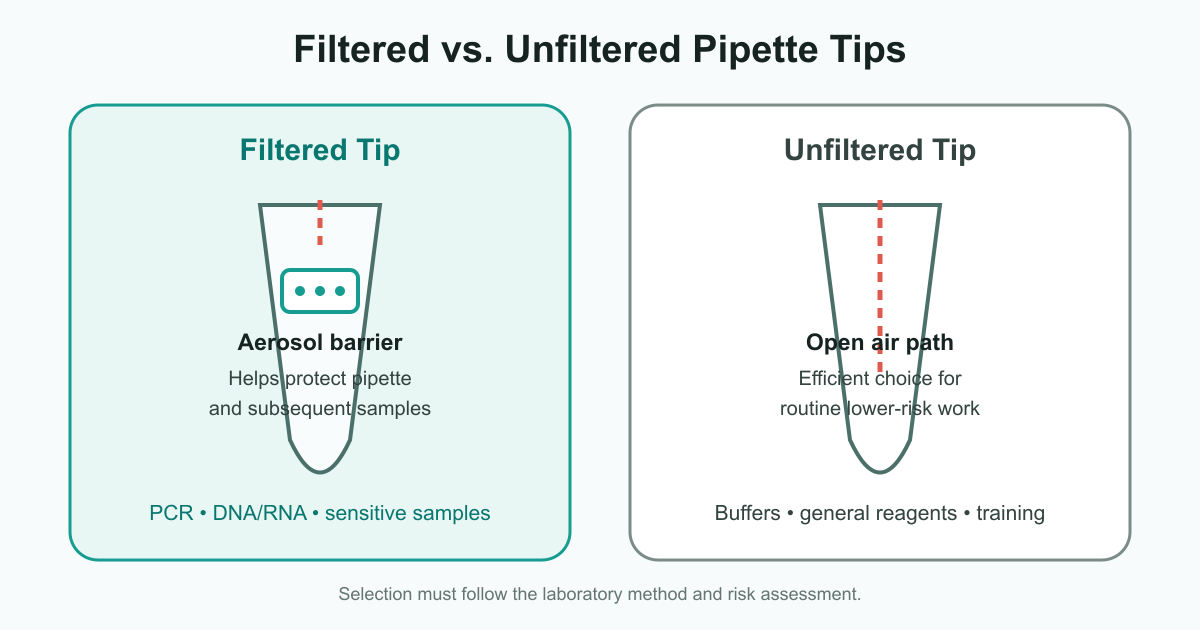
The Fisher Scientific selection guide explains that aerosols created during pipetting may enter the pipette and contaminate later samples. A filter helps interrupt this pathway, but it does not replace correct technique or laboratory controls.
Quick Comparison
| Factor | Filtered tips | Unfiltered tips |
|---|---|---|
| Aerosol barrier | Yes | No |
| Typical use | Contamination-sensitive work | Routine liquid transfer |
| Common examples | PCR/qPCR, DNA/RNA work, sensitive samples | Buffers, general reagents, training |
| Cost | Usually higher | Usually lower |
| Sterile by definition | No | No |
Filtered and sterile are not synonyms. Filtered describes the presence of a barrier; sterile describes a validated sterilization status. Always check both specifications.
When Should You Use Filtered Pipette Tips?
Filtered tips are usually the stronger choice when contamination of the sample or pipette would have meaningful consequences.
PCR, qPCR and nucleic-acid work
Small amounts of carryover can compromise amplification workflows. Filtered tips help separate pipetting aerosols from the internal components of the pipette. Also confirm whether the product has the required DNase-free, RNase-free or other documented purity status.
Contamination-sensitive cell culture
Filtered tips can add protection when unintended contamination could affect cell-culture results. They do not replace aseptic technique, a clean workspace or the laboratory’s standard operating procedure.
Potentially hazardous samples
A filter provides an additional barrier between the sample and instrument. Appropriate containment, personal protective equipment and decontamination procedures are still required.
Shared pipettes
Where several users share equipment, filtered tips can help reduce internal contamination and subsequent carryover. Pipette maintenance and correct handling remain essential.
When Are Unfiltered Tips Appropriate?
Unfiltered tips are suitable for many routine, lower-risk applications, including general reagent transfer and preparation of non-critical buffers.
They may be preferable when:
- The method does not require an aerosol barrier.
- The material is not especially contamination-sensitive.
- Correct volume and pipetting technique are used.
- A fresh tip is used whenever the workflow requires it.
- Lower consumable cost or reduced material use is important.
Browse the NEST Liquid Transfer range to compare available formats.
Five Checks Before Ordering
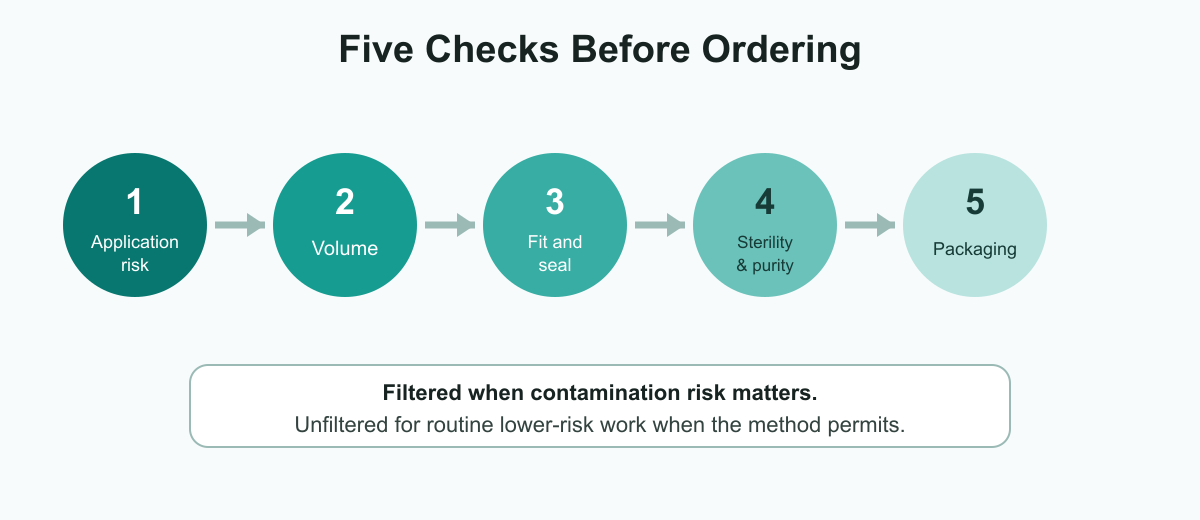
1. Application risk
Start with what happens if the sample or pipette becomes contaminated. Sensitive molecular assays require different controls from routine buffer transfers.
2. Tip volume
Choose a tip designed for the working volume. The current NEST catalogue covers universal and filter configurations from 10 to 1000 µL, including selected extra-long formats.
3. Fit and seal
A poor fit can cause leakage, inconsistent aspiration and sample loss. “Universal” does not guarantee identical performance on every pipette. The Sartorius technical overview also emphasizes the importance of the seal between pipette and tip.
4. Sterility and purity
Check whether the workflow requires sterile, DNase-free, RNase-free, pyrogen-free or other documented specifications. These terms are not interchangeable. Available quality records can be checked through the NEST COA/COC service.
5. Packaging
Racked tips simplify organized loading and sterile handling. Bulk tips may be economical for routine use, while refill systems can reduce the number of complete boxes required.
NEST offers sterile racked pipette tips in multiple volumes. Confirm the exact filter, volume, purity and packaging configuration before ordering.
Can Filtered Pipette Tips Be Autoclaved?
Do not assume every filtered tip can be autoclaved. Heat may affect the tip, filter, surface treatment or validated performance. Follow the instructions for the exact product.
This is especially important for specialty surfaces: the NEST catalogue states that its low-binding tips must not be autoclaved because high temperature may affect low-binding performance.
The Simple Rule
Use filtered tips when aerosol or carryover contamination would create a meaningful experimental, safety or quality risk. Use unfiltered tips for routine, lower-risk work when the method permits them.
Then confirm the correct volume, fit, sterility, purity and packaging. For help matching a tip configuration to your workflow, contact NEST Scientific Europe or add the product to the quote request list.
Frequently Asked Questions
Are filtered pipette tips always sterile?
No. Filter and sterile status must be checked separately.
Do filtered tips improve accuracy?
Not automatically. Accuracy depends on tip fit, pipette condition, selected volume, technique, calibration and liquid properties.
Can unfiltered tips be used for PCR?
Some methods may permit them, but filtered tips are commonly selected when aerosol or carryover contamination could compromise the workflow. Follow the laboratory’s validated method.
What is the difference between filter and low-binding tips?
A filter helps control aerosols or liquid moving toward the pipette. A low-binding surface is intended to reduce sample retention. A product may combine both features, but they address different problems.