
Free EU Shipping on Orders €200+ 🚚
Free EU Shipping on Orders €200+ 🚚
Free EU Shipping on Orders €200+ 🚚



An Erlenmeyer flask is a conical laboratory vessel used for mixing, handling and, in suitable formats, culturing liquids. The narrow neck helps limit splashing during swirling, while the broad base keeps the flask stable. For cell-culture work, choosing the right material, size, bottom and cap matters as much as choosing the flask itself.

Quick summary
Erlenmeyer flasks—often called conical flasks in British English—serve several laboratory roles. Traditional glass versions are common in chemistry, whereas sterile plastic shaker flasks are designed for suspension culture, microbial culture, media preparation, mixing and storage. The best choice depends on the process rather than capacity alone.
What is an Erlenmeyer flask?
An Erlenmeyer flask has a flat or shaped base, a conical body and a relatively narrow cylindrical neck. This geometry gives liquid room to move while making the vessel easier to swirl than a straight-sided container. The name “conical flask” generally refers to the same basic vessel; it is especially familiar to readers in the UK and other European markets.
The graduations molded or printed on many flasks are useful for checking an approximate fill level. They are not a substitute for calibrated volumetric glassware when a method requires precise volume preparation. A volumetric flask is designed around one accurate calibration mark, while an Erlenmeyer flask is primarily a working vessel.
What is an Erlenmeyer flask used for?
The answer depends on the flask material and construction. In general laboratory work, an Erlenmeyer flask may be used to mix solutions, dissolve materials, receive liquid during a titration or hold a reaction mixture. Heating is appropriate only when the flask material, manufacturer instructions and laboratory method explicitly allow it.
Sterile plastic Erlenmeyer shaker flasks address a different set of workflows. They are commonly selected for:
- suspension cell culture;
- bacterial or yeast culture;
- preparation and mixing of media or buffers;
- seed cultures and process-development work;
- temporary storage when the selected closure is suitable.
The conical body supports mixing on an orbital shaker, but culture performance is not determined by shape alone. Working volume, shaking speed, orbital diameter, bottom geometry, closure and the needs of the cell line all affect the process.
Erlenmeyer flask vs. conical flask: are they different?
In most laboratory contexts, Erlenmeyer flask and conical flask are two names for the same basic design. “Erlenmeyer” is widely used in North American product terminology, while “conical flask” is common in British English.
Do not confuse a conical flask with a conical centrifuge tube. A centrifuge tube is a narrow tube designed for compatible centrifugation workflows; an Erlenmeyer flask has a much broader base and is commonly used for mixing or shaking. Product specifications should always determine the permitted application.
How to choose between PETG and PC Erlenmeyer flasks
PETG and polycarbonate (PC) are both used for disposable or ready-to-use shaker flasks, but they should not be treated as interchangeable without checking the process requirements.
PETG is a practical option for routine single-use workflows that benefit from a clear, lightweight flask. NEST small-size PETG Erlenmeyer flasks cover common small-scale culture and preparation needs.
PC is often selected when laboratories want a robust flask and a wider choice of bottom configurations. NEST small-size PC Erlenmeyer flasks include flat-bottom and baffled-bottom options for different mixing requirements.
Before choosing either material, verify the required temperature range, chemical compatibility, sterilisation method and closure configuration against the product documentation and your laboratory protocol. Material alone does not determine whether a flask is suitable for a particular culture or reagent.
Choosing 250 mL, 500 mL or 1000 mL Erlenmeyer flasks
A flask’s stated capacity is its nominal vessel size, not a universal recommended working volume. A 250 mL Erlenmeyer flask may suit screening or smaller seed-culture steps, while 500 mL and 1000 mL formats provide more room for larger preparation or culture stages. The correct working volume must still be established for the specific method.
Start with four questions:
- How much liquid does the protocol require?
- How much headspace is needed for mixing and gas exchange?
- Which flask sizes fit the shaker platform and clamps?
- Does the next process step require a particular closure or transfer method?
For larger suspension-culture volumes, compact platform use may become more important than small-flask flexibility. NEST high-efficiency Erlenmeyer flasks are available for larger-scale workflows where shaker-space use and flask configuration need to be considered together.
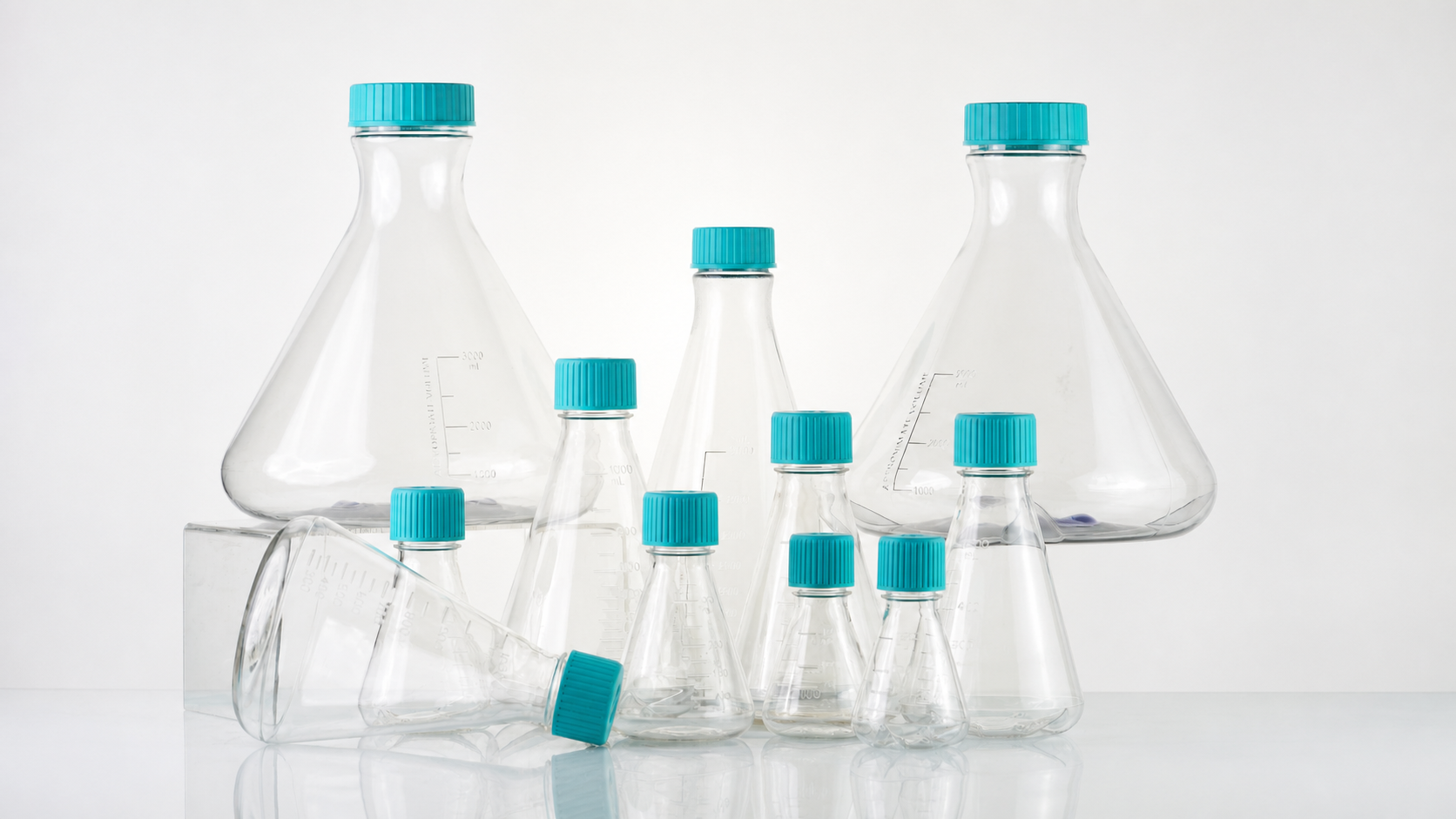
Flat-bottom vs. baffled Erlenmeyer flasks
A flat-bottom flask provides a familiar, comparatively smooth internal surface. It is a sensible starting point for routine mixing and for cultures where a gentler hydrodynamic environment is preferred.
A baffled flask has molded features in the base that interrupt the circular liquid flow. This can increase mixing and gas exchange, but it may also increase shear. The practical result depends on the complete system: flask geometry, liquid volume, shaking conditions and organism or cell line.
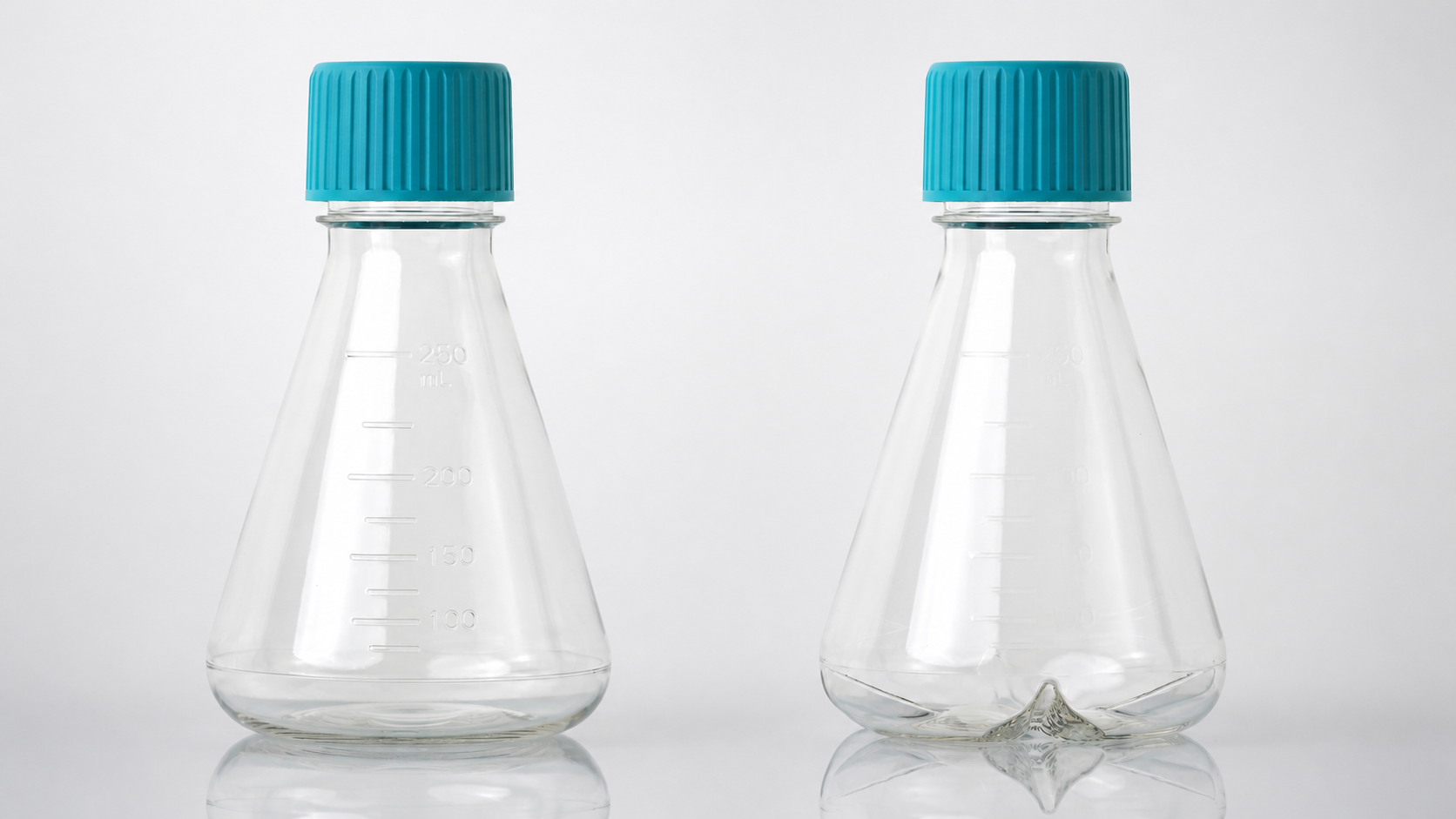
Choose a baffled flask when the process has a demonstrated need for stronger agitation or oxygen transfer. Choose a flat-bottom flask when a simpler flow pattern better fits the method. If a process is being transferred between the two, validate the new conditions instead of assuming equivalent performance.
Seal cap vs. vent filter cap
The closure controls how the flask interacts with the surrounding environment. A seal cap is appropriate when the process calls for a closed closure, subject to the manufacturer’s instructions and the pressure limitations of the vessel. A vent filter cap is intended for workflows that require gas exchange while maintaining a protective barrier.
For cell culture, cap selection should be made alongside working volume and shaking conditions. A vented cap does not by itself guarantee adequate oxygen transfer, and a sealed vessel may be unsuitable for an actively respiring culture. Confirm the protocol and product documentation before use.
Common mistakes when selecting an Erlenmeyer flask
The most common error is selecting by capacity alone. A 500 mL flask can behave differently depending on its material, bottom geometry, cap and actual fill volume.
Other avoidable mistakes include:
- treating molded graduations as precision measurements;
- assuming every Erlenmeyer flask can be heated or autoclaved;
- ignoring chemical compatibility;
- changing from flat to baffled without process verification;
- using a seal cap when gas exchange is required;
- overlooking shaker clearance, clamps and platform capacity.
A short equipment check before purchase is more reliable than correcting a mismatch after the culture process has begun.
Frequently asked questions
Is an Erlenmeyer flask the same as a conical flask?
Usually, yes. “Conical flask” is a common British English name for the same basic laboratory vessel. Specific products may still differ in material, base, cap and intended application.
Can an Erlenmeyer flask be heated?
Only if its material, product instructions and laboratory procedure permit heating. Do not apply the heat tolerance of laboratory glassware to a plastic cell-culture flask.
What size Erlenmeyer flask should I choose?
Choose from the required liquid volume, headspace, mixing conditions, shaker compatibility and next process step. Nominal capacity alone is not enough.
When should I use a baffled flask?
Consider a baffled flask when the process needs more vigorous mixing or gas transfer. Because baffles can also increase shear, confirm suitability for the organism or cell line and validate the operating conditions.
Conclusion
An Erlenmeyer flask can be a general laboratory mixing vessel or a specialised shaker flask for cell and microbial culture. Select it by application first, then confirm material, nominal size, working volume, bottom design and cap. To compare available configurations, explore NEST’s PETG and PC Erlenmeyer flasks, or contact NEST Scientific Europe for product-selection support.